Keyword Research Best Practices for B2B SaaS
Keyword research is the backbone of any successful SEO strategy — and for B2B SaaS companies, it’s even more crucial. In a crowded market where every software product claims to “solve” a problem better than the rest, understanding how your audience searches online can mean the difference between scaling your traffic and wasting your marketing budget.
In this guide, we’ll explore the best practices for keyword research in B2B SaaS, how to use Ahrefs and Semrush effectively, and how agencies like SerpZenith.com can help you identify profitable keyword opportunities to grow faster.
Understanding B2B SaaS Keyword Research
Keyword research for B2B SaaS isn’t just about finding high-volume search terms — it’s about identifying keywords that align with your customer’s buying journey. Unlike B2C, SaaS users go through longer decision cycles, with stages like:
- Awareness: Searching for problems (“how to manage customer data securely”)
- Consideration: Comparing solutions (“best CRM for enterprise”)
- Decision: Searching for vendors or pricing (“HubSpot CRM alternatives”)
To win in SaaS SEO, your content must map to these stages — and that starts with smart keyword selection.
Why Keyword Research Matters More in SaaS
- Longer Sales Funnels: The average SaaS buyer researches multiple solutions before converting.
- High Customer Lifetime Value (CLV): Every organic lead matters because subscription revenue compounds.
- High Competition: Established players dominate SERPs; finding new entry points through keyword gaps is key.
- Ever-changing Technology Terms: SaaS terminology evolves quickly — “AI-powered CRM” didn’t even exist five years ago.
That’s why precise keyword targeting through tools like Ahrefs and Semrush is essential.
Using Ahrefs for SaaS Keyword Research
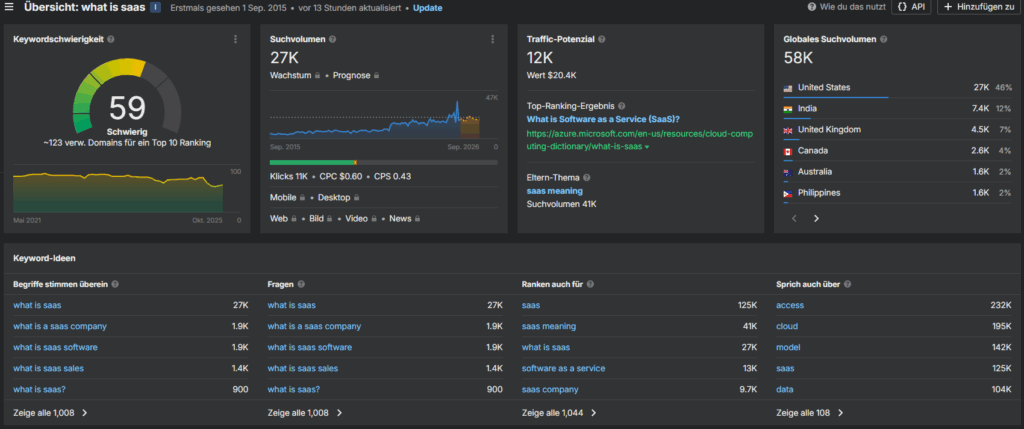
Ahrefs remains one of the most comprehensive tools for discovering keyword gaps, search intent, and competitive opportunities in SaaS niches.
Step 1: Analyze Competitors
Enter your top competitors’ domains in Ahrefs’ Site Explorer. You’ll instantly see:
- Which keywords they rank for
- Traffic potential per keyword
- Content types driving most organic visits
Focus on competitors offering similar SaaS models or pricing tiers — not just the biggest brands.
Step 2: Identify Keyword Gaps
Use Content Gap analysis to find keywords your competitors rank for but you don’t.
Example: if HubSpot, Zoho, and Salesforce rank for “pipeline management software,” and you don’t — that’s a clear content gap.
Step 3: Evaluate Search Intent
Ahrefs’ Keyword Explorer shows intent categories (informational, navigational, transactional).
Filter keywords where transactional intent matches your SaaS offering, like “project management tools for startups” or “cloud ERP pricing.”
Step 4: Check SERP Difficulty
Always consider the Keyword Difficulty (KD) score. In SaaS, even 20-30 KD can be tough due to strong domains.
Target clusters of medium-difficulty keywords (KD 15–40) to rank faster.
Step 5: Monitor Trends
Use Ahrefs’ “Newly Discovered” keywords feature to catch rising SaaS trends early — for example, “AI meeting summarizer” or “no-code automation tool.”
Using Semrush for SaaS Keyword Research
Semrush complements Ahrefs beautifully. Where Ahrefs focuses on backlinks and SERP data, Semrush excels at keyword clustering, intent grouping, and topic strategy.
Step 1: Keyword Magic Tool
Search your primary SaaS keyword (“CRM software,” “ERP SaaS,” etc.) in Keyword Magic Tool.
Then use filters:
- Include modifiers: “software,” “tool,” “platform”
- Exclude non-relevant verticals
- Group by topic: “CRM for sales,” “CRM for healthcare,” etc.
Step 2: Analyze SERP Features
Semrush shows if a keyword triggers featured snippets, FAQs, or People-Also-Ask boxes.
For SaaS content, target terms that trigger feature snippets — like “how to integrate CRM with Gmail.”
Step 3: Discover Question Keywords
Semrush’s “Questions” filter is gold for SaaS blogs.
Examples:
- “What is SaaS onboarding?”
- “How to reduce churn in B2B SaaS?”
- “Best SaaS CRM for startups?”
Answering these with detailed posts improves topical authority and supports long-tail SEO.
Step 4: Map Keywords to Funnel Stages
Create a keyword map aligned with your SaaS funnel:
- Top of Funnel (TOFU): “What is workflow automation?”
- Middle of Funnel (MOFU): “Workflow automation tools for small business”
- Bottom of Funnel (BOFU): “Best workflow automation SaaS for startups”
This ensures your content nurtures leads progressively.
Step 5: Track Keyword Cannibalization
SaaS websites often have multiple similar product pages. Use Semrush’s Position Tracking to detect overlapping keywords and consolidate them into stronger pillar content.
Combining Ahrefs + Semrush Insights
The real power comes when you combine both tools:
| Goal | Use Ahrefs For | Use Semrush For |
|---|---|---|
| Competitor Analysis | Domain-level organic keyword data | Topic & SERP structure |
| Keyword Discovery | Keyword Gap + Explorer | Keyword Magic Tool + Intent filters |
| Tracking & Trends | Rank tracking + Content decay alerts | Position tracking + Visibility score |
| Content Planning | Identify linkable assets | Cluster by funnel stage |
Using both provides a 360° SEO strategy — one focuses on what to target, the other on how to rank.
Long-Tail Keywords: The Hidden Goldmine
B2B SaaS users often use specific, long-tail queries. Example:
- “email automation tool for healthcare startups”
- “best payroll software for freelancers in Germany”
These keywords have:
- Lower competition
- Higher conversion intent
- Better alignment with niche SaaS offerings
Use Ahrefs’ “Phrase Match” + Semrush’s “Questions” to find such gems.
Analyzing Search Intent Correctly
Search intent drives content success. There are four main intent types relevant to SaaS:
- Informational: “what is SaaS onboarding?”
- Navigational: “HubSpot CRM login”
- Commercial: “HubSpot vs Pipedrive comparison”
- Transactional: “buy project management software”
Each needs a different content type — blog, comparison page, case study, or landing page. Aligning keyword intent with content type improves rankings and user experience.
Building Topic Clusters for SaaS SEO
Google now rewards topical authority. Instead of isolated articles, build topic clusters:
- Main pillar: “CRM Software for Small Businesses”
- Supporting blogs: “How CRM improves sales efficiency,” “Best CRM integrations,” “Top CRM tools for freelancers”
Interlink all pages — Ahrefs’ Site Audit helps track internal linking; Semrush shows topic gap opportunities.
Evaluating Keyword Performance
After publishing, continuously evaluate:
- Rankings (via Ahrefs/ Semrush)
- CTR and engagement (via Google Search Console)
- Conversions and demo sign-ups (via analytics tools)
For SaaS, don’t just chase traffic — track how many sign-ups or free trials come from SEO content.
Avoiding Common Keyword Research Mistakes
- Targeting only high-volume keywords without intent match
- Ignoring low-volume but high-conversion terms
- Overlapping pages (keyword cannibalization)
- Focusing on one keyword per page instead of clusters
- Ignoring branded search opportunities
A balanced mix of head terms, mid-tail, and long-tail keywords delivers both short-term traffic and long-term stability.
Leveraging AI & NLP for SaaS Keyword Research
Modern SEO tools use Natural Language Processing (NLP) to find semantically related entities.
Use AI-powered keyword clustering or topic extraction to identify:
- Related concepts (“customer retention,” “ARR growth,” “SaaS metrics”)
- Synonyms & intent variants (“software,” “platform,” “solution”)
- Subtopics for pillar expansion (“lead scoring,” “data integration,” “automation workflows”)
This helps you align your content with Google’s semantic search systems (BERT, MUM, etc.) and rank for a wider range of queries.
When to Get Expert Help
Keyword research can be time-consuming — especially in competitive B2B SaaS niches.
That’s where expert agencies like SerpZenith.com come in.
Our team specializes in:
- Advanced keyword gap analysis with Ahrefs & Semrush
- Topic clustering for SaaS funnels
- Semantic keyword mapping & entity optimization
- Content briefs tailored for writers and SEO tools
If you want to scale your SaaS organic growth with data-driven keyword strategies, reach out to SerpZenith — we’ll help you dominate your niche.
Final Thoughts
Keyword research for B2B SaaS isn’t just about finding words — it’s about understanding how your ideal users think, search, and decide.
By mastering tools like Ahrefs and Semrush, mapping intent to the funnel, and focusing on long-tail, high-intent queries, you’ll build a content engine that attracts qualified leads month after month.
And if you want expert help — remember: SerpZenith.com offers professional keyword research and full-service SEO strategies tailored for SaaS growth.