What is Moz Domain Authority (DA)? How It Works & How to Increase It
If you have spent any time in SEO, you have probably seen the term Moz Domain Authority, also known as DA. It is one of the most recognized SEO metrics in the industry and is often used to estimate how strong a website might be in search results. Many agencies, bloggers, link sellers, and website owners use it when comparing domains, checking competitors, or evaluating backlink opportunities.
The reason DA became popular is simple. It gives people an easy number to look at when they want to judge a website’s authority. But just like any SEO metric, it can be useful or misleading depending on how you use it. Some people see a high DA and assume the website must be strong in Google. Others ignore it completely because it is not a direct Google metric. The truth sits in the middle.
Moz Domain Authority is helpful when you understand what it is designed to do and what it cannot do. Once you learn how it works, you can use it in a smarter way for SEO audits, outreach, link building, competitor review, and domain evaluation.
Understanding what Moz Domain Authority means
Moz Domain Authority is a predictive score developed by Moz. It estimates how likely a domain is to rank in search engine results compared with other domains. The score ranges from 1 to 100, with higher numbers generally suggesting stronger ranking potential.
This score is relative, not absolute. That means a DA 50 website is not automatically good or bad on its own. Its value depends on the niche, the competition, and the other websites you are comparing it against. In some industries, DA 20 can already be decent. In more competitive spaces, even DA 50 may not stand out.
Moz created this metric to give SEO professionals a way to compare websites at domain level. It is not meant to replace real SEO analysis. It is meant to support it.
How Moz calculates Domain Authority
Moz calculates Domain Authority using a mix of signals related to backlinks and overall domain strength. These signals include linking root domains, backlink quality, and other link-related factors that feed into Moz’s prediction model.
The important point is that DA is based on Moz’s own system and data. It is not taken from Google, and it is not a direct reflection of how Google scores websites. Moz uses its own algorithm to estimate how competitive a domain may be in search results.
Because of this, DA may change when Moz updates its index or model. Your website may gain or lose DA even if you did not make major changes, simply because the broader data set changed. That is why DA should be treated as a comparative SEO metric, not a fixed truth.
Why Domain Authority matters in SEO
Domain Authority matters because it helps compare websites quickly. If you are doing outreach, competitor research, or backlink analysis, a metric like DA can save time. It gives you a fast way to sort domains before doing deeper checks.
For example, if you are reviewing possible guest post websites, DA can help you filter weak domains from stronger ones. If you are comparing your site against competitors, DA can show whether their domain-level authority looks stronger than yours from Moz’s point of view.
In commercial SEO, DA is also used in reporting, sales conversations, backlink pricing, and opportunity screening. Clients often understand a number more easily than a complex explanation about authority. That is one reason this metric stayed popular for so long.
What Domain Authority does not measure
Moz DA can be useful, but it does not tell you everything.
It does not guarantee rankings. It does not tell you how much traffic a site gets. It does not confirm whether the content is useful, current, or aligned with search intent. It also does not tell you whether a site is relevant to your niche.
A domain can show a strong DA and still be a poor SEO asset if it has weak topical relevance, outdated pages, or an unnatural backlink profile. In the same way, a lower DA website can still rank well if it has focused content, strong internal linking, and better intent matching.
This is why experienced SEO professionals do not rely on DA alone. They use it as one part of a bigger review process.
DA vs DR what is the difference
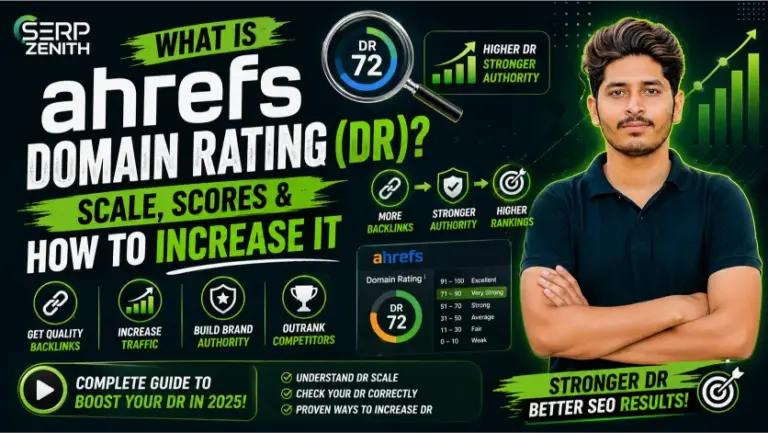
A common question is the difference between Moz Domain Authority and Ahrefs Domain Rating. Both try to measure domain-level strength, but they are created by different companies using different datasets and formulas.
DA is more about predicting ranking ability within Moz’s model. DR is more focused on backlink profile strength in Ahrefs’ model. Since they use different systems, the same website can have very different scores in DA and DR.
That does not mean one is always right and the other is wrong. It simply means they are different tools. Good SEO work often uses multiple metrics to build a fuller picture instead of trusting just one number.
Is a high DA website always a good backlink opportunity
No, and this is one of the biggest mistakes people make.
A high DA site may look attractive, but you still need to check whether it is relevant, active, indexed, and trustworthy. If the website publishes unrelated content, sells links openly, or looks abandoned, a strong DA may not help much.
The best backlink opportunities are usually websites that combine decent authority with real relevance and healthy site quality. If the website fits your topic and publishes useful content for real users, the link is more likely to make sense in the long run.
This matters even more today because search engines are better at judging context. A link should not only come from an authoritative site. It should also fit naturally within the content and the niche.
How businesses and agencies use DA
Agencies use DA for several practical reasons. It helps in prospecting. It helps in reporting. It helps in setting expectations when talking to clients about authority growth. It also helps when evaluating publishers for outreach or sponsored placements.
Businesses may use it to see whether their website is becoming more competitive over time. If the backlink profile improves and more strong domains are linking in, DA may rise. This can be a helpful directional signal.
At the same time, smart businesses know that DA should not become the final goal. The real goal is better search visibility, better leads, and better conversions. DA supports that process, but it does not replace it.
What is a good DA score
There is no single DA number that is good for every site. A strong DA depends on the market you are competing in.
For a small or newer website, even moderate authority may be enough to compete in less aggressive niches. For industries like finance, software, health, or national services, the authority bar is usually much higher.
Instead of chasing an arbitrary number, it is better to compare your DA with the websites you want to outrank. If the top competitors are all significantly stronger, you may need more authority, better content, or both. If your DA is already close to theirs, improving page quality and relevance may be enough to close the gap.
Why DA should be checked with traffic and relevance
A website with high DA but zero meaningful traffic deserves a closer look. There may be a reason why the authority score looks good while the search performance does not. It could be a weak content strategy, poor technical setup, loss of rankings, or simply a low-value website built around metrics instead of real users.
This is why traffic and relevance should always be checked alongside DA. A site with moderate DA, steady traffic, and clear niche alignment can be more useful than a stronger but irrelevant domain.
If you are buying links, reviewing guest post sites, or selecting partners, this combined view gives you far better judgment than a single metric ever will.
Common mistakes people make with Moz DA
One mistake is treating DA as if it were a Google score. It is not. Another mistake is using it as the only filter when buying links or reviewing websites. This often leads to wasted budget.
Some people also compare websites across completely different niches without context. A DA score only becomes meaningful when it is tied to actual competition. A DA 30 site in one industry may be strong, while in another it may barely register.
Another common mistake is trying to increase DA for appearance rather than performance. If the metric rises but rankings, traffic, and leads do not improve, then the score alone is not delivering real business value.
How to improve Domain Authority
The most reliable way to improve DA is to improve the quality of your backlink profile over time. This means earning links from better websites, building content worth referencing, and avoiding weak or manipulative backlink tactics.
Useful content often plays a major role here. Strong guides, original resources, research content, industry pages, and genuinely helpful articles are more likely to earn backlinks than thin pages written only for search engines.
Outreach can also help when done properly. Building relationships, offering value, contributing useful content, and getting mentioned on relevant websites can strengthen the domain naturally. The goal should be to build a backlink profile that supports rankings, not just a score that looks good in a dashboard.
Why DA still matters even though it is not from Google
Some people dismiss DA because it is not a Google metric. That is understandable, but it misses the practical value of third-party SEO tools.
A metric does not need to come from Google to be useful. It only needs to help you make better decisions. DA can do that when used correctly. It can help compare sites, spot authority gaps, filter outreach targets, and understand how your domain may be perceived relative to others.
The danger only comes when people confuse a helpful benchmark with an absolute truth. DA is a useful signal. It is not the full SEO picture.
When expert SEO support can help
Many website owners know they need stronger authority, but they are not sure how to build it in a safe and effective way. They may spend money on backlinks, guest posts, or content placements without knowing whether the websites they choose are actually worth it.
This is where professional SEO support can be valuable. A proper strategy looks beyond DA and checks the full quality of the opportunity. It considers niche fit, page health, organic performance, indexing, and long-term value. That helps businesses avoid weak placements and build authority that supports real rankings.
If your goal is to grow domain strength in a way that also supports traffic and business visibility, the right SEO approach can make the process much more efficient.
Final thoughts on Moz Domain Authority
Moz Domain Authority remains one of the best-known SEO metrics for a reason. It gives a quick view of domain-level authority and helps compare websites in a simple way. It is useful for outreach, competitor analysis, link research, and general SEO planning.
But like every third-party metric, it works best when used with context. DA is not a shortcut to perfect SEO decisions. The strongest approach is to use it alongside relevance, traffic, content quality, and technical review.
If you use Domain Authority as a helpful benchmark instead of treating it as the whole story, it can become a practical part of a much smarter SEO strategy.
Frequently Asked Questions
What is Moz Domain Authority in simple terms
Moz Domain Authority is a score from 1 to 100 that predicts how likely a domain is to rank in search results compared with other websites.
Is Domain Authority a Google metric
No. Domain Authority is a third-party metric created by Moz. It is not an official Google ranking score.
Does a higher DA mean better rankings
Not always. A higher DA can suggest stronger authority, but rankings still depend on content quality, search intent, relevance, and many other SEO factors.
What is a good Domain Authority score
A good DA score depends on your niche and competition. It is better to compare your score with direct competitors rather than chasing a random number.
Can a low DA website rank well
Yes. A lower DA site can still rank if it targets the right keywords, has useful content, and is better optimized than competitors.
Should I use DA when buying backlinks
You can use it as a starting filter, but not as the only factor. You should also check relevance, traffic, quality, and indexing before making a decision.
How do I increase Moz Domain Authority
You improve DA by building a stronger backlink profile over time through quality links, useful content, and a cleaner overall SEO strategy.
Is DA more important than traffic
No. DA and traffic show different things. DA gives a view of authority, while traffic shows real visibility and performance. Both should be reviewed together.