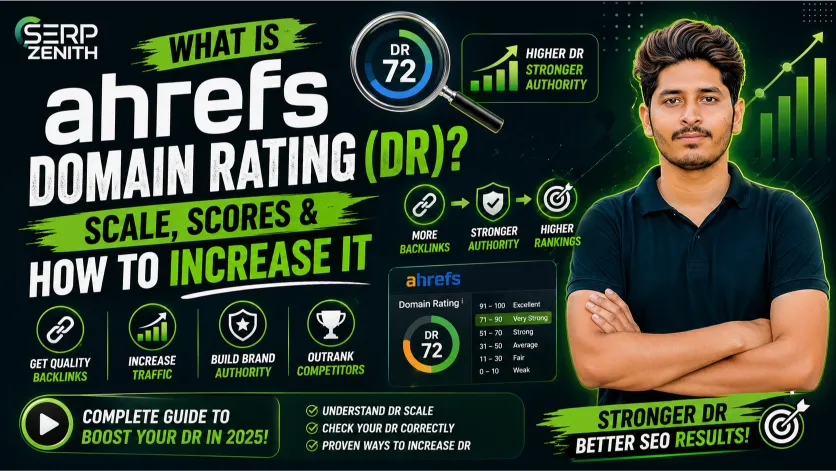
What is Ahrefs Domain Rating (DR)? Scale, Scores & How to Increase It
If you work in SEO, link building, guest posting, expired domains, or website authority analysis, you have probably seen the term Ahrefs Domain Rating, usually called DR. Many people check this number before buying a domain, placing a backlink, or judging the strength of a website. The problem is that a lot of beginners see a high DR and assume the website is automatically powerful in Google. That is not always true.
Ahrefs Domain Rating is a useful SEO metric, but it needs to be understood the right way. If you rely on it without knowing what it actually measures, you can make poor decisions when building links, evaluating PBN domains, or comparing sites in your niche. A website can have a strong DR and still bring very little ranking value if the link profile is weak, manipulated, or unrelated.
This is why it is important to understand what DR means, how Ahrefs calculates it, what affects it, and where people usually get confused. Once you understand the real purpose of this metric, you can use it better in SEO campaigns, backlink research, domain selection, and authority building.
Understanding what Ahrefs Domain Rating means
Ahrefs Domain Rating is a score from 0 to 100 that shows the relative strength of a website’s backlink profile compared to other websites in the Ahrefs database. In simple words, it tells you how strong a domain looks from a link authority point of view.
This score is logarithmic, which means moving from DR 20 to DR 30 is much easier than moving from DR 70 to DR 80. That is why even a small increase at higher levels can be difficult. A new website usually starts very low, and as it earns more backlinks from referring domains, its DR may grow over time.
The key point here is that DR mainly focuses on backlinks pointing to the whole domain. It does not directly measure content quality, traffic, conversions, or how trustworthy a business is in real life. It is a link-based metric, not a complete SEO score.
How Ahrefs calculates DR
Ahrefs calculates Domain Rating based on the quantity and strength of referring domains linking to a website. Not all links are treated equally. A link from a stronger site can carry more value than a link from a weak site. At the same time, if one website links out to many domains, the value passed from that site can be diluted.
This means DR is not just about collecting random backlinks. The authority of the linking domains also matters. If your site earns links from websites that Ahrefs sees as strong and authoritative, your DR can grow faster than if you get many links from low-quality sources.
Ahrefs also looks at dofollow links more seriously for this metric. That is why many SEO professionals focus on acquiring quality dofollow backlinks from relevant and trusted websites instead of chasing large volumes of weak links.
Why DR matters in SEO
Domain Rating matters because it gives SEO professionals a quick way to estimate the link strength of a domain. It helps when comparing websites, checking competitors, reviewing guest post opportunities, or filtering expired domains.
For example, if you are considering outreach placements, a site with decent topical relevance and a healthy DR may look more attractive than a site with very low authority. If you are studying competitors, DR can also give you a rough idea of how aggressive their backlink profile is. It can help you understand why some domains are harder to outrank than others.
In commercial SEO work, DR is often used when selling backlinks, pricing guest posts, evaluating expired domains, and building authority strategies for clients. This is where understanding the metric properly becomes valuable. A smart SEO does not just look at DR. A smart SEO checks whether the domain is relevant, indexed, active, and capable of helping rankings in a natural way.
What DR does not tell you
This is where many people make mistakes. Ahrefs DR does not tell you everything about a website.
A high DR does not guarantee strong organic traffic. It does not guarantee rankings. It does not confirm topical relevance. It does not tell you whether the site is clean or spammed. It also does not tell you if the website is getting real visitors or is only inflated by backlinks.
A domain can have DR 50 or higher and still be a poor link opportunity if the site is off-topic, abandoned, filled with low-value content, or part of a manipulated network. On the other side, a lower DR site in the right niche with real traffic and strong content can sometimes be a much better choice.
So if you only look at DR and ignore everything else, you can waste time and money.
DR vs traffic which one matters more
A common question in SEO is whether DR matters more than traffic. The real answer is that both matter, but they serve different purposes.
DR helps you understand link authority. Traffic helps you understand visibility and real search performance. If a website has good DR but no real traffic, you should ask why. Maybe the site has backlinks but weak content. Maybe it lost rankings. Maybe it is not active anymore. Maybe the niche is unrelated to your project.
If a site has both healthy DR and steady relevant traffic, that is usually a better signal. It suggests the website has some authority and can also attract real search users. For link building, this combination is often stronger than DR alone.
How DR helps in guest posting and backlink buying
When people buy guest posts or niche edits, DR is often one of the first filters they use. This is understandable because it saves time. If you have a list of hundreds of sites, DR can help you narrow them down.
But buying links based only on DR is risky. A strong link opportunity should be judged using multiple checks. The site should be relevant to your niche. It should have indexed pages. Its content should look natural. The traffic should make sense. The outbound links should not look spammy. The site should not exist only to sell links.
A backlink from a well-maintained site with moderate DR, good relevance, and real activity can often be more useful than a link from a high DR site that publishes anything for anyone.
This matters even more now because search engines are becoming better at understanding context, relevance, and overall site quality. Link authority still matters, but link quality matters even more.
Using DR for expired domains and PBN research
If you work with expired domains, DR is one of the first numbers people check. It can help you quickly spot domains that once earned backlinks from strong websites. That can be useful. But it should never be your only check.
Before selecting an expired domain, you should also review the backlink history, anchor text profile, previous content theme, index status, spam signs, and referring domain quality. A domain may still show a good DR while having a damaged history. If the backlinks are irrelevant, lost, redirected strangely, or clearly manipulated, the DR number will not save you.
For private blog networks or authority rebuild projects, the best expired domains are usually the ones that combine clean history, niche relevance, solid referring domains, and stable value over time. DR can support the decision, but it should not make the decision alone.
Why some websites have high DR but weak SEO results
This confuses many beginners. A website may have strong DR and still struggle in search results. There are several reasons for that.
The content may be thin or outdated. The site may not match search intent. Internal linking may be weak. Technical SEO issues may block performance. The backlink profile may be strong at domain level but not support important pages properly. In some cases, the domain may simply be in a highly competitive niche where authority alone is not enough.
This is why serious SEO work cannot be reduced to one metric. DR is helpful, but rankings depend on many signals working together. Content quality, search intent, page optimization, crawlability, internal links, user trust, and topical depth all matter.
What is a good Ahrefs DR score
There is no universal DR score that is good for every project. A good DR depends on your niche, competition, and goals.
For a small local business website, even modest authority can be enough if the site is well optimized and the competition is weak. For affiliate SEO, SaaS, finance, or national-level services, the required authority may be much higher.
In general, very low DR often means a site has little link authority. Mid-range DR can already be useful in many niches if the site is relevant and active. Very high DR is harder to achieve and usually seen on established websites, strong brands, major publishers, and powerful domains.
The real question should not be, “Is this DR high?” The better question is, “Is this DR strong enough for my niche, and is the site actually useful?”
DR and topical relevance should work together
A backlink from a highly relevant site can be more useful than a stronger but unrelated domain. This is one of the biggest truths in practical SEO.
If your website is about digital marketing, a backlink from a relevant marketing, business, or SaaS site may make more sense than a link from a random high DR domain about an unrelated topic. Search engines do not look at raw authority only. They also understand context.
That is why smart link building focuses on both authority and relevance. DR helps with the authority side. Niche fit helps with the context side. When both are present, the backlink profile usually looks more natural and valuable.
Common mistakes people make with Domain Rating
Many people use DR the wrong way and then wonder why their SEO strategy does not work well.
One mistake is thinking DR equals Google ranking power in every case. Another mistake is assuming all high DR sites are good for backlinks. A third mistake is ignoring traffic, relevance, and site quality while chasing strong numbers.
Some people also compare websites only by DR without considering page-level strength. In reality, a specific page may matter more than the whole domain, especially when you are reviewing a backlink placement or trying to rank a target URL. Domain-level metrics help, but page-level strength still matters.
A final mistake is trying to increase DR just for appearance. If you grow DR without building real SEO value, the number may look nice in reports, but rankings and leads may not improve.
How to increase Ahrefs Domain Rating the right way
If you want to grow DR naturally, the best path is to earn better referring domains over time. This usually happens through quality link building, strong content, digital PR, outreach, partnerships, guest contributions, and useful resources people want to reference.
You do not need thousands of random links. What matters more is earning links from websites that are relevant, active, and trusted. When the backlink profile grows in a clean and sensible way, DR may improve as a byproduct.
It also helps to publish content that deserves links. Guides, research pages, tools, comparison content, case studies, and original resources often attract stronger backlinks than thin promotional pages.
For businesses that want faster growth, professional backlink strategy can help. The important thing is to focus on link quality, not just metric inflation.
Should businesses care about DR
Yes, but in the right way. Businesses should care about DR as a reference metric, not as the only goal.
If you run an agency, SaaS company, affiliate project, local service business, or eCommerce site, DR can help you understand your domain’s backlink strength compared with others. It can guide outreach targets and show whether your authority is improving over time.
At the same time, businesses should care more about rankings, qualified traffic, leads, and revenue. DR is useful because it supports SEO decisions. It is not useful if it becomes a vanity score with no business result behind it.
When professional SEO help makes sense
Many website owners know that backlinks matter, but they are not sure which websites are worth targeting, how to check domain quality, or how to avoid wasting money on weak placements. That is where professional SEO support can make a real difference.
A good SEO strategy does not just chase high DR domains. It looks at niche fit, organic visibility, backlink quality, page indexing, content standards, and long-term ranking potential. This saves budget and helps build authority that actually supports growth.
If your goal is to improve rankings, strengthen domain authority, and build links that make sense for Google as well as users, working with someone who understands metrics like DR in a practical way can save you from costly mistakes.
Final thoughts on Ahrefs Domain Rating
Ahrefs Domain Rating is a strong and useful metric when used correctly. It helps measure the relative strength of a domain’s backlink profile and gives SEO professionals a quick way to compare websites. It can be valuable for outreach, competitor analysis, guest posting, expired domain research, and authority planning.
But DR should never be treated as the full story. A good website is not defined by one score. Relevance, traffic, content quality, trust, and overall SEO health matter just as much. The best results come when DR is used as one part of a bigger decision-making process.
If you understand that balance, you can use Ahrefs DR more intelligently and make better choices in your SEO work.
Frequently Asked Questions
What is Ahrefs DR in simple words
Ahrefs DR is a score from 0 to 100 that shows how strong a website’s backlink profile is compared to other sites in the Ahrefs database. It helps estimate domain-level link authority.
Is Ahrefs Domain Rating a Google ranking factor
No, DR itself is not a Google ranking factor. It is a third-party metric created by Ahrefs. However, the backlinks behind the metric can still influence SEO performance.
Is higher DR always better
Not always. A higher DR can be useful, but it does not automatically mean the website is better for rankings, traffic, or backlinks. Relevance and site quality matter too.
Can a website with low DR still rank on Google
Yes. A lower DR website can still rank well if the content is strong, the search intent is matched, and the competition is manageable.
Does DR measure traffic
No. DR measures backlink strength, not traffic. A site can have high DR and low traffic, or lower DR and good traffic.
Should I buy backlinks only from high DR sites
No. You should also check relevance, traffic, content quality, indexation, and spam signals. A high DR alone is not enough.
How long does it take to improve DR
It depends on how many quality referring domains you earn and how strong they are. DR usually grows over time through consistent link building and authority development.
Is DR important for expired domains
Yes, but it should never be the only factor. You should also check history, backlinks, anchors, niche relevance, and spam signs before buying an expired domain.